USPTO Pre-Order Procedure: A Patent Owner's Playbook
April 1, 2026: USPTO gives patent owners a new 30-day pre-order window in ex parte reexamination. What belongs in the paper, and when filing it actually helps.
On April 1, 2026, USPTO Director John Squires signed an Official Gazette Notice creating a new procedural window for patent owners in ex parte reexamination. Effective for any request filed on or after April 5, 2026, patent owners now have 30 days from service of a reexamination request to file a "pre-order paper" arguing that the cited references do not raise a substantial new question of patentability. No petition. No fee. Up to 30 pages.
What the rule actually does
The procedure is narrow. The pre-order paper may argue only that the references in the request do not raise a substantial new question under 35 U.S.C. 303(a). The 30 days run from service of the request, not from USPTO docketing. Third-party requesters may respond only by petition under 37 CFR 1.182, with a 10-page cap. Missing the window does not waive later rights to file the patent owner's statement, but it forecloses the pre-order shot. The Director invoked his waiver authority under 37 CFR 1.183 to suspend the usual rules barring pre-order patent owner submissions.
Why 95% is the baseline
The procedure matters because the SNQ determination has rarely blocked a request. Across the 5,200+ utility-patent ex parte reexaminations since 2012, the USPTO has granted SNQ in roughly 95% of cases. (More on the substantial-new-question standard.)
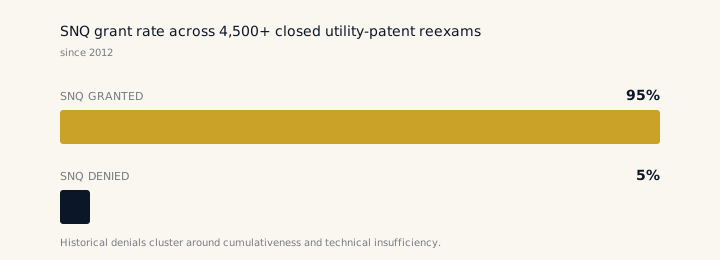
Historical denials have clustered around two grounds: cited prior art that was cumulative of references already considered during prosecution, or technical disclosure too thin to raise a new question. Under the Notice, novelty-of-teaching and pure cumulativeness arguments are generally directed to the post-order patent owner statement under 37 CFR 1.530, where they can be developed with full briefing. The pre-order paper's clearest lane is technical insufficiency: showing that the cited references do not actually disclose what the request claims they disclose.
What belongs in a strong pre-order paper
The Notice frames the paper narrowly. It must argue why the prior art teachings in the request do not establish a substantial new question. The Notice directs three categories of argument away from the pre-order paper:
- 35 U.S.C. 325(d) discretionary denial, which is addressed only after the SNQ determination.
- Novelty-of-teaching arguments, which the Notice indicates should be made later in the patent owner statement under 37 CFR 1.530.
- Incorporation by reference as a drafting technique, which is not permitted in the pre-order paper.
What works inside those guardrails is a targeted attack on the teaching itself. Where the cited art does not actually disclose what the request claims it does, the pre-order paper should walk through the alleged disclosure element by element. Vague characterizations of prior art are where requests tend to be weakest, and a tight technical rebuttal is what the SNQ standard rewards.
When it's worth filing
The pre-order paper is not free. Filing it previews the patent owner's defenses to the examiner before the SNQ decision, giving the examiner a chance to address them in the order itself. The procedure has highest value where the cited art is technically thin (does not actually disclose what the request claims) and where the assigned examiner's historical denial rate runs above the 5% index average. Where the references actually teach what the request says and the examiner rarely denies, the pre-order paper signals without leverage.
What to watch
First pre-order outcomes land by summer 2026. The question for practitioners: does this procedure raise the historical 5% denial rate, or just delay reexams that would have been ordered anyway?
Frequently asked questions
What is the USPTO's pre-order procedure for ex parte reexamination?
On April 1, 2026, USPTO Director Squires signed an Official Gazette Notice creating a new 30-day pre-order window for patent owners in ex parte reexamination. Effective for requests filed on or after April 5, 2026, patent owners may file a pre-order paper arguing that the cited references do not raise a substantial new question of patentability, before the USPTO orders reexamination. No petition or fee is required.
Sources: Cooley
How long is the pre-order paper window?
30 days from service of the reexamination request. The window is non-extendable, and the deadline runs from service rather than from USPTO docketing.
Sources: Stradling
What arguments can the pre-order paper make?
The pre-order paper must argue why the references in the request do not raise a substantial new question of patentability under 35 U.S.C. 303(a). The Notice directs three categories of argument away from the pre-order paper: 35 U.S.C. 325(d) discretionary denial arguments (addressed after the SNQ determination), novelty-of-teaching arguments (reserved for the post-order patent owner statement under 37 CFR 1.530), and incorporation by reference as a drafting technique. The clearest lane is technical insufficiency of the cited references.
Sources: Stradling
Can third-party requesters respond to the pre-order paper?
Only by petition. A third-party requester may respond to a patent owner's pre-order paper by filing a petition under 37 CFR 1.182, subject to a 10-page cap and the standard petition fee. Without a petition, the requester has no automatic reply right at the pre-order stage.
Sources: Cooley