Substantial New Question Explained: The 95% Reexam Gate
What 'substantial new question of patentability' means under 35 U.S.C. 303(a), why the USPTO grants SNQ in 95% of cases, and where the 5% denials concentrate.
"Substantial new question of patentability" is the gate to every ex parte reexamination. Get past it and the procedure moves to the merits. Fail it and the request never receives an order. Most requests clear the gate. Across the 4,500+ utility-patent reexams since 2012, the USPTO grants SNQ in roughly 95% of cases. But understanding what the standard actually requires is the difference between a request that gets ordered and one that gets sent back.
The statutory standard
35 U.S.C. 303(a) provides that within three months following the filing of a reexamination request, the USPTO Director must determine whether a substantial new question of patentability is raised. The statute itself does not define "substantial new question." The standard has developed through MPEP guidance and Federal Circuit case law.
MPEP 2242 frames the inquiry in two parts: the question must be substantial, and it must be new. (For the procedure that begins after SNQ is granted, see How an Ex Parte Reexamination Works.)
Substantial
A question is "substantial" if a reasonable examiner would consider the prior art important to the patentability of any claim. The bar is materially lower than the merits determination that follows in the reexam itself. Substantiality asks whether the art is relevant to patentability, not whether it would defeat the claim.
This is one reason the historical grant rate runs so high. The substantial prong filters out frivolous prior art, not weak prior art.
New
A question is "new" if the prior art teaching has not been previously considered. Three subcategories matter in practice:
- References never previously cited. The clearest path. If a reference was never in the prosecution record, the question it raises is new.
- References previously cited but not substantively addressed. A reference appearing on an IDS but never discussed in an office action may still raise a new question.
- Previously considered references in a new technical light. A reference rejected on one ground may raise a new question on a different ground or against different claims.
Congress amended 35 U.S.C. 303(a) in 2002 (Public Law 107-273) to clarify that prior consideration of a reference is not, by itself, dispositive. The amendment effectively overruled In re Portola Packaging, Inc., 110 F.3d 786 (Fed. Cir. 1997), which had held that the PTO could not base reexamination solely on prior art previously considered. After the 2002 amendment, the question is whether the question raised is new, not whether the reference itself appeared in the prior record. Pre-2002 doctrine on cumulativeness no longer governs.
The 95% grant rate
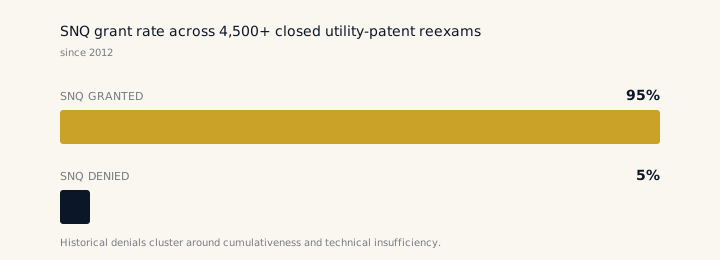
Across the 4,500+ closed ex parte reexams since 2012, the USPTO has granted SNQ in roughly 95% of cases. The grant rate is high because requesters self-select. Most requests come from sophisticated parties (third-party defendants in litigation, patent owners managing portfolio risk) who would not file weak SNQ arguments.
For practitioners drafting requests, see Drafting an SNQ Request That Survives.
The 5% denial rate concentrates in two scenarios:
- Cumulative references. The cited art is materially the same as references already considered. This is the most common denial ground.
- Technical insufficiency. The references do not actually disclose what the request claims they disclose. Less common, but determinative when raised.
Some examiners run denial rates above the average. Across the 110+ active reexam examiners, denial rates range from approximately 3% on the low end to over 15% on the high end. The examiner's historical denial pattern is a meaningful input to the realistic probability of an order.
Why it matters
The SNQ determination is structurally important for three reasons.
First, it is the only gate. Once SNQ is granted and the request is ordered, the merits play out across the office action sequence. The SNQ determination is the only formal threshold the procedure imposes.
Second, it is procedural. The determination is made on the request alone, without formal patent owner participation in most cases. Patent owners have to anticipate what the examiner will see and pre-position the case strategically.
Third, it sets the frame for the rest of the case. A reexam that clears SNQ on a thin record sometimes settles into a quick certificate. One that clears on a thoroughly developed record often runs through multiple office actions and an appeal.
For practitioners, the operating rule is this: assume SNQ will be granted (it is, 95% of the time), but draft the request as if the determination were the load-bearing argument. The procedural record built at the SNQ stage shapes everything that follows.
Frequently asked questions
What is a substantial new question of patentability?
A substantial new question of patentability (SNQ) is the threshold standard an ex parte reexamination request must meet for the USPTO to order reexamination. Under 35 U.S.C. 303(a), within three months of filing, the USPTO determines whether the request raises a question that is both substantial (a reasonable examiner would consider the prior art important to the patentability of a claim) and new (not previously considered during prosecution).
Sources: Fish & Richardson
How often does the USPTO grant SNQ in ex parte reexamination?
Historically, the USPTO grants SNQ in approximately 95% of ex parte reexamination requests. The high grant rate reflects requester self-selection: most requests come from sophisticated parties whose prior art has been chosen to meet the threshold.
Sources: Sterne Kessler
What makes a question of patentability substantial?
A prior art reference raises a substantial question if there is a substantial likelihood that a reasonable examiner would consider it important in deciding whether a claim is patentable. The standard does not require that the prior art necessarily render any claim unpatentable. The bar is materially lower than the merits determination that follows in the reexamination.
Sources: Sterne Kessler