Ex Parte Reexamination: Process, Fees, Timeline and Outcomes
How USPTO ex parte reexamination works in 2026: who can file, fees, the new pre-order paper, median timelines and outcomes, from nearly 5,000 reexams.
Ex parte reexamination is a USPTO proceeding that lets anyone ask the Office to take a second look at an issued patent's claims, based on prior patents and printed publications. If the request raises a substantial new question of patentability, an examiner reexamines the claims and the case ends with a certificate that confirms, amends or cancels them. It costs a fraction of an IPR, can be filed anonymously and creates no estoppel against the requester, which is why filings have more than doubled since 2024.
This guide covers how the procedure works step by step, what it costs, how long it takes and how cases end, using ExamPat's data on nearly 5,000 utility-patent reexaminations filed since 2012, the statute and rules, and recent commentary from practitioners.
How much does ex parte reexamination cost? The USPTO fee for a streamlined request is $6,775 for a large entity, $2,710 for a small entity and $1,355 for a micro entity patent owner, before attorney fees.
How long does it take? The median request reaches a certificate 364 days after filing without an appeal, and 943 days with a PTAB appeal, according to ExamPat's analysis of USPTO records.
At a glance
| Who can file | Anyone, including the patent owner, at any time during the period of enforceability |
| What it can rely on | Prior patents and printed publications only |
| Threshold | A substantial new question of patentability (SNQ) |
| USPTO request fee | $6,775 large entity, $2,710 small entity, $1,355 micro entity patent owner (streamlined request of 40 pages or fewer) |
| SNQ decision | Due within 3 months by statute. Median 45 days |
| Certificate | Median 364 days without an appeal, 943 days with one |
| Grant rate | About 95% historically, about 92% in the first half of 2026 |
| Requester's role after the order | One reply at most, no appeal |
| Estoppel on the requester | None |
Who can file
Under 35 U.S.C. 302, any person can request reexamination of any claim of an issued patent. Patent owners file to shore up claims before asserting them or to deal with art they've found since issuance. Third parties file far more often: across the cases ExamPat tracks, 94% of requests came from third parties, typically accused infringers, licensees and challenger organizations.
A request can be filed at any time during the patent's period of enforceability, which MPEP 2211 describes as generally the expiration date plus six years, and longer when litigation is pending. That makes reexam available against expired patents still being asserted for past damages.
Requesters can stay anonymous by filing through a registered practitioner. A February 2026 USPTO notice added one condition: if any challenged claim already received an IPR or PGR final written decision, the anonymous request should state that the requester and its real parties in interest aren't the earlier petitioner or its privies, or the filing date may be vacated. A proposed rule published in July 2026 would go further and require every third-party request to name all real parties in interest, kept confidential on request. As of this update it hasn't been finalized. (More on anonymous filings.)
What the request must contain
The request, governed by 37 CFR 1.510, has to identify every claim challenged and the prior art relied on, and explain in detail how that art applies to each claim and why it raises a substantial new question. It must include copies of the art and the patent, and a third-party requester must serve the patent owner and certify that it isn't barred by IPR or PGR estoppel.
Only patents and printed publications count. Public use, on-sale activity and indefiniteness arguments can't start a reexam, though the examiner can raise 112 issues on amended or new claims once the case is underway.
Practitioners writing about the 2026 changes give consistent advice on drafting: make the first request as complete as possible, identify the new teaching precisely and tie it to the limitation that got the claims allowed. The requester rarely gets another chance. (How to draft a strong SNQ request.)
Fees
These are the USPTO fees from the fee schedule last revised August 14, 2026. Third-party requesters can't use micro entity rates.
| Fee | Large entity | Small entity | Micro entity |
|---|---|---|---|
| Request, streamlined (40 pages or fewer) | $6,775 | $2,710 | $1,355 (patent owner only) |
| Request, not streamlined | $13,545 | $5,418 | $2,709 (patent owner only) |
| Each independent claim added over 3 and over the patent's count | $600 | $240 | $120 |
| Each claim added over 20 and over the patent's count | $200 | $80 | $40 |
| Petition in a reexam proceeding | $2,195 | $878 | $439 (patent owner only) |
| Notice of appeal to the PTAB | $905 | $362 | $181 |
| Forwarding an appeal to the PTAB | $2,535 | $1,014 | $507 |
A request qualifies as streamlined when its body runs 40 pages or fewer, with at least 1.5 line spacing and a 12 point font. Copies of the references, the patent and the required certifications don't count toward the limit. If the Office refuses the request, part of the fee is refunded under 35 U.S.C. 303(c). Sources: USPTO fee schedule, 37 CFR 1.20 and 37 CFR 41.20.
Fees last verified: October 2026.
The pre-order paper (new in 2026)
For requests filed on or after April 5, 2026, the patent owner can respond before the Office decides whether to order reexamination. An Official Gazette notice signed by Director Squires lets the owner file a pre-order paper of up to 30 pages, plus declarations, within 30 days of service of the request. There's no fee and no extension.
The paper is limited to arguing that the request doesn't raise a substantial new question. It can't incorporate other documents by reference or argue 325(d), and arguments that a teaching isn't new are left for later. The requester can answer only through a petition under 37 CFR 1.182, with a fee, in up to 10 pages within 15 days.
Practitioners are split on it. Squire Patton Boggs sees a net benefit for patent owners, and BakerHostetler reported a July 2026 denial where the owner's pre-order arguments carried the day. Novak Druce argued in October 2026 that it's often a trap, because the owner previews its defenses to the same examiner who will run the reexam. Harness IP counted pre-order papers in about 42% of eligible cases in the second quarter of 2026. (Our full breakdown of the pre-order procedure.)
The SNQ decision
Within three months of filing, the Office decides whether the request raises a substantial new question of patentability under 35 U.S.C. 303. The question is new if the art's teaching wasn't considered in the same light during prosecution, and substantial if a reasonable examiner would consider it important to patentability. Art that was cited before can still raise one. (The SNQ standard explained.)
In practice the decision comes much faster than the deadline. The median request in ExamPat's data got its decision 45 days after filing, and half of all decisions landed between 33 and 62 days.
Most requests clear this gate. Every year from 2013 through 2025, between 93% and 98% of decided requests were granted, about 95% on average. The first half of 2026 ran lower, at about 92%, below every full year since 2012, as the pre-order paper took effect and the Office began applying 325(d) to some reexam requests. (How the 2026 grant rate fell.)
A decision that there's no substantial new question is final and can't be appealed, though the requester can petition the Director for review.
Discretionary denial under 325(d)
Separate from the SNQ test, 35 U.S.C. 325(d) lets the Director reject a request when the same or substantially the same art or arguments were already presented to the Office. For years this was rare in reexam. That changed in 2026, after a year of discretionary IPR denials. In May 2026 the Office denied a request under 325(d) because its art had been argued in an IPR petition that was itself denied on discretionary grounds, without the Board ever reaching the merits.
Mintz read that decision as a warning that a reexam isn't a guaranteed fallback after an IPR: art presented in an IPR petition counts as presented, even if nobody considered it. Its advice was to pick one vehicle rather than file both. ExamPat's data on requests filed after a discretionary IPR denial tells a more mixed story. (Is reexam still worth filing after a discretionary IPR denial?)
The order and the patent owner's statement
If the Office finds a substantial new question, it orders reexamination. The patent owner then has at least two months to file a statement under 37 CFR 1.530, which can include narrowing amendments and new claims. If the owner files one, a third-party requester gets a single reply within two months under 37 CFR 1.535.
That reply is the end of the requester's active role. Under 37 CFR 1.550(g), it keeps receiving copies of office actions but can't take part in interviews or file anything further on the merits. If the owner skips the statement, there's no requester reply at all, which is why many owners go straight to the first office action.
Examination
From here the case runs much like ordinary prosecution, but with "special dispatch" under 35 U.S.C. 305. A reexamination examiner issues a first office action, rejecting claims under 102 or 103 over patents and printed publications. The median first action in ExamPat's data came 178 days after filing.
Unexpired claims get their broadest reasonable interpretation. Claims of an expired patent are read under the Phillips standard used in court, since they can't be amended, according to MPEP 2258.
The patent owner can argue, file declarations, hold interviews with the examiner and amend claims, but amendments can only narrow. Section 305 bars any amendment that enlarges a claim's scope, and claims of an expired patent can't be amended at all.
Most cases need only one or two rounds. Among cases that ended in a certificate, 38% needed a single office action, and the average was 1.8. Who examines the case matters a great deal: pendency and outcomes vary widely from one reexam examiner to the next. (Why the examiner matters.)
Timeline
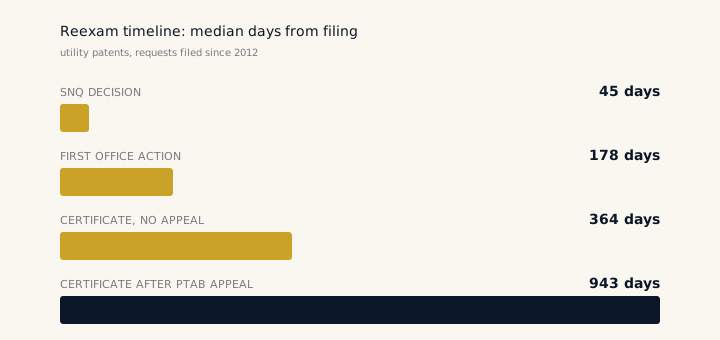
| Milestone | Median days from filing | Middle half of cases |
|---|---|---|
| SNQ decision | 45 | 33 to 62 |
| First office action | 178 | 139 to 235 |
| Certificate without an appeal | 364 | 282 to 463 |
| Certificate after a PTAB appeal | 943 | 756 to 1,212 |
Figures cover utility-patent requests filed since 2012, measured from the filing date.
The typical reexam without an appeal finishes in about a year. Counting appealed and unappealed cases together, half of all certificates issued between 303 and 609 days after filing. An appeal to the PTAB is what stretches a case out: certificates in appealed cases took a median of 943 days, about two and a half years.
Courts and the Office both treat reexam as time sensitive. Under MPEP 2286, the Office expedites a reexam to the extent possible when litigation has been stayed for it.
Appeals
Only the patent owner can appeal. Under 35 U.S.C. 306, the owner can appeal a final rejection to the PTAB and then to the Federal Circuit. A third-party requester can't appeal and, per MPEP 2273, can't take part in the owner's appeal.
About 21% of the cases that ended in a certificate went through a PTAB appeal first.
How reexams end
A reexam ends with a reexamination certificate under 35 U.S.C. 307, which cancels claims found unpatentable, confirms claims found patentable and adds any amended or new claims. Of the cases in ExamPat's data that have closed, 91% ended with a certificate, 5% were denied at the SNQ stage and 4% were terminated for procedural reasons.
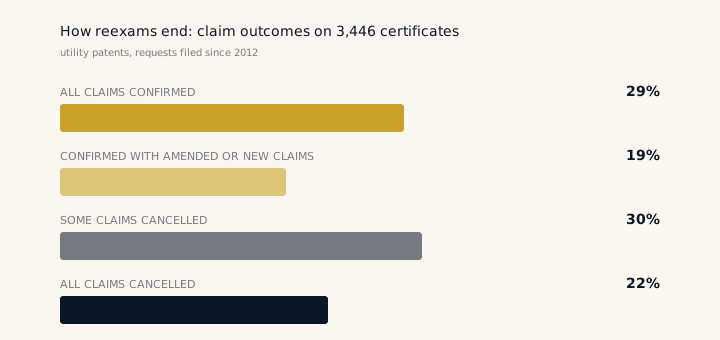
The certificate outcome split is closer to even than the high grant rate suggests. On 3,446 certificates, 29% confirmed every reexamined claim unchanged and another 19% confirmed claims alongside amended or new ones. Thirty percent cancelled some claims while confirming or amending others, and 22% cancelled every claim reexamined. In other words, about half of all certificates cancelled at least one claim.
Amended or new claims carry intervening rights under 35 U.S.C. 252, as MPEP 2293 explains. Someone who made or used the product before the certificate issued may be able to keep doing so, which limits what an owner gains by amending its way out of a rejection.
Estoppel and litigation
Ex parte reexamination creates no statutory estoppel against the requester. A defendant can request reexam and still raise the same art in court, which is one of the procedure's biggest draws compared with IPR. The bar runs only one way: a petitioner that gets an IPR or PGR final written decision can't later request reexamination on grounds it raised or reasonably could have raised, under 35 U.S.C. 315(e)(1). (More on estoppel.)
A pending PTAB rule could add a second link. The USPTO's October 2025 proposal would bar IPR on claims already found patentable in an earlier third-party reexam. Fish & Richardson reported the final rule went to the White House for review in July 2026, and it hadn't been published as of this update.
District courts often stay patent cases while a reexam runs, especially once it's ordered. In July 2026 the Federal Circuit declined to disturb a stay pending reexam in Lambeth Magnetic Structures v. Seagate, saying it wouldn't overturn a stay without a clear right to relief.
Ex parte reexamination vs IPR
| Ex parte reexamination | Inter partes review | |
|---|---|---|
| Who can file | Anyone, including the patent owner | Anyone but the owner, within a year of being sued |
| Anonymous filing | Yes, through a practitioner | No, real parties in interest must be named |
| Threshold | Substantial new question | Reasonable likelihood of prevailing, plus discretionary review |
| Requester's role | Request and one reply | Full trial with discovery and a hearing |
| Who decides | A reexamination examiner | A panel of administrative patent judges |
| Estoppel on the challenger | None | Yes, in court and at the Office |
| Claim amendments | Narrowing amendments and new claims freely | Limited motion to amend |
| Requester appeal | No | Yes |
The shift since 2025 has been dramatic. After the USPTO rescinded the Fintiv memo in February 2025, made Sotera stipulations no longer decisive and moved IPR institution decisions to the Director, IPR institution became far harder to predict. Reexam filings rose in response. ExamPat counts 321 utility-patent requests filed in 2024, 561 in 2025 and 714 so far in 2026. Practitioner counts differ by method, but all point the same way: Harness IP reported a record 336 requests in the second quarter of 2026 alone. (How reexam overtook the IPR.)
The statute and rules in one place
- 35 U.S.C. 301: citing prior art and written statements in a patent's file
- 35 U.S.C. 302: who can request reexamination
- 35 U.S.C. 303: the substantial new question determination
- 35 U.S.C. 304: the order, owner's statement and requester's reply
- 35 U.S.C. 305: conduct of the proceeding, no broadening amendments
- 35 U.S.C. 306: the patent owner's appeal
- 35 U.S.C. 307: the certificate and intervening rights
- 37 CFR 1.510: contents of a request
- 37 CFR 1.530: the patent owner's statement and amendments
- 37 CFR 1.535: the requester's reply
- 37 CFR 1.550: conduct of the proceeding
- MPEP chapter 2200: the USPTO's procedures for reexamination. It hasn't yet been revised for the 2026 notices.
About the data
ExamPat tracks every utility-patent ex parte reexamination filed since 2012, built from USPTO records and updated daily. Figures in this guide cover 4,944 requests filed from January 2012 through October 19, 2026. Grant rates count requests ordered against requests denied, by the date of the decision, and leave out the most recent months because denials tend to be recorded late. Timelines are medians, measured from the filing date.
Frequently asked questions
What is ex parte reexamination?
Ex parte reexamination is a USPTO proceeding in which an examiner takes a second look at an issued patent's claims in light of prior patents or printed publications. Anyone can request it, including the patent owner. If the request raises a substantial new question of patentability, the Office orders reexamination and the case then runs between the examiner and the patent owner.
Sources: 35 U.S.C. 302
Who can file an ex parte reexamination request?
Any person can file, including the patent owner, an accused infringer, a licensee or an anonymous requester acting through a registered practitioner. A request can be filed at any time during the patent's period of enforceability, which generally runs six years past expiration and longer when litigation is pending.
Sources: MPEP 2211
How much does ex parte reexamination cost?
The USPTO request fee is $6,775 for a large entity filing a streamlined request of 40 pages or fewer, and $13,545 for a longer request. Small entities pay $2,710 and $5,418. A patent owner that qualifies as a micro entity pays $1,355 and $2,709, but third-party requesters can't use micro entity rates. Attorney fees for preparing the request are separate and usually much larger than the government fee.
Sources: USPTO fee schedule
How long does an ex parte reexamination take?
Across nearly 5,000 utility-patent reexaminations filed since 2012, the median request got its SNQ decision 45 days after filing and a first office action at 178 days. Certificates issued at a median of 364 days when there was no appeal and 943 days when the patent owner appealed to the PTAB, according to ExamPat's analysis of USPTO records.
How often is ex parte reexamination granted?
Historically about 95% of requests that reached a decision were granted, and every year from 2013 through 2025 landed between 93% and 98%. The rate ran lower in the first half of 2026, at about 92%, as patent owners began filing pre-order papers and the Office began applying 325(d) to some requests.
Can a third-party requester appeal or take part after the order?
No. A third-party requester can file one reply if the patent owner files a statement after the order, and that ends its active participation. The requester receives copies of office actions but can't join interviews, can't appeal and can't take part in the patent owner's appeal.
Sources: MPEP 2273
Does ex parte reexamination create estoppel?
No statute creates estoppel against a requester from an ex parte reexamination, which is a key difference from IPR. The bar runs the other way: a petitioner that receives an IPR or PGR final written decision is barred from requesting reexamination on grounds it raised or reasonably could have raised.
Sources: 35 U.S.C. 315
What is the pre-order paper in ex parte reexamination?
Since April 5, 2026, a patent owner can file a paper of up to 30 pages within 30 days of being served with a request, arguing that the request doesn't raise a substantial new question. There's no fee and no extension. The requester may answer only by petition, in up to 10 pages within 15 days.
Sources: USPTO Official Gazette notice