Sotera Rescission One Year On: The Data Behind the Reexam Surge
One year after Sotera Stipulations stopped being dispositive against discretionary IPR denial, ex parte reexamination filings have surged 81%. Where displaced petitioners went.
A year ago, the USPTO Director rescinded the prior agency position that a Sotera Stipulation would foreclose discretionary denial of an IPR petition. The Office called it a clarification. The market called it a turning point. Twelve months of data confirm the second reading.
What the Sotera rescission did
The Sotera Stipulation, named for the petitioner in Sotera Wireless, Inc. v. Masimo Corp., IPR2020-01019 (Paper 12, Dec. 1, 2020), is a petitioner's commitment not to raise in another forum the same grounds raised at PTAB. For years, a properly worded Sotera Stipulation was effectively dispositive against discretionary denial under the Fintiv framework: the PTAB would generally institute. On February 28, 2025, USPTO Acting Director Coke Morgan Stewart rescinded the June 2022 Vidal memorandum that had treated the stipulation as dispositive. A follow-on Stewart memo issued on March 26, 2025 set out interim Fintiv-evaluation guidance. After the change, even a Sotera-stipulated petition could be discretionarily denied. The downside risk of filing an IPR, that the petition would be denied and the petitioner would be left without leverage, became real again.
The volume signal
Ex parte utility-patent reexam filings ran 198, 299, 299, 316, and 330 in 2020 through 2024, a flat-to-modest trajectory. In 2025, they jumped to 598, an 81% one-year increase and the strongest single-year surge in the procedure's modern history. Early 2026 filing pace tracks the late-2025 rate rather than the pre-rescission baseline.
Filing counts in this article cover utility-patent ex parte reexaminations. Design and reissue reexams are tracked separately.
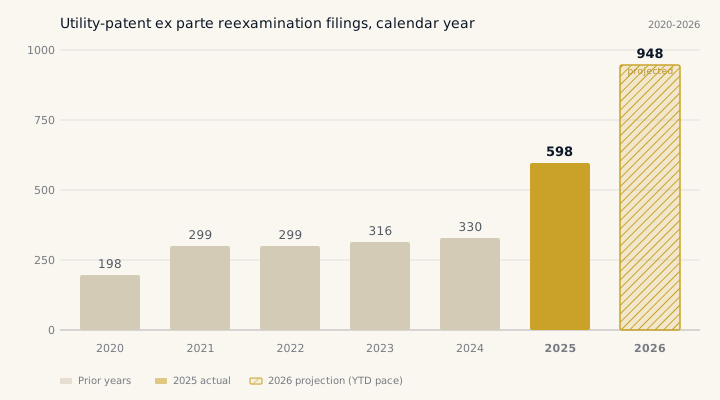
The composition is third-party. 561 of 598 calendar-year 2025 filings (94%) were third-party challenges. Patent owner filings ran 37 in absolute terms, near the historical patent-owner baseline. The surge sits entirely on the challenger side.
Unified Patents reported a Q3 2025 quarterly high of 198 filings, a single quarter that exceeded the entire 2020 calendar year. The acceleration through 2025 maps closely to the procedural sequence: a pre-rescission first quarter on the prior baseline, a transition through mid-year, and a post-rescission new normal by Q3.
Where the displaced petitioners went
A challenger with strong prior art on a patent in district court litigation had three procedural options after the Sotera rescission: file an IPR and accept the new discretionary-denial risk, push the invalidity case forward in district court, or substitute ex parte reexam. The volume data suggests reexam absorbed most of the diversion.
The structural appeal of reexam tracks the change. No estoppel attaches to a reexam outcome under 35 U.S.C. 315(e), versus the IPR estoppel that bars later litigation on the same grounds. There is no institution gauntlet. The procedure does not require a stipulation. The cost is lower. For a defendant building parallel-track invalidity exposure, the asymmetry favors the procedure that does not lock in a position. (What estoppel actually does in reexam, and what it doesn't.)
The diversion is also visible at the firm level. Firms with established IPR practices have built parallel ex parte reexam playbooks through the year. The Sterne Kessler "Resurgence and Perils of Ex Parte Reexaminations" piece, published in 2025, captures the institutional rethink that was happening in real time.
What one year of data does not yet show
Two things are still uncertain after twelve months.
First, whether the SNQ denial rate holds. Across the 5,200+ reexams since 2012, the historical SNQ denial rate is roughly 5%. The 2025 cohort brought a wider population of requesters to the procedure, many migrating from IPR practice with prior art tuned to PTAB rather than to the SNQ standard. Whether examiners hold the line at 5% under that pressure, or whether the denial rate climbs, will only resolve as the 2025 cohort's SNQ determinations close out through 2026.
Second, whether the Federal Circuit weighs in. Several reexams now in process trace directly to parallel district court litigation. CAFC review of the reexam-certificated patents that emerge from this cohort is the next-out plot point. Reversal rates and the procedural deference standards the Court applies will shape how aggressively challengers continue to use the procedure.
What the data does show
The Sotera rescission is not the only thing that mattered in 2025. The broader move toward discretionary IPR denial, the change in USPTO leadership, and the procedural review at the PTAB all played roles. But it is the first explanation that survives the data. A near-doubling of filings in one calendar year, almost entirely on the third-party side, tracks too closely to the March policy reset to be coincidence.
One year on, the procedural pivot is structural. The market is not waiting to see if IPR comes back.