State of Ex Parte Reexamination: 2026 Preview
Mid-year snapshot of ex parte reexamination at the USPTO. Filings up 81% in 2025 and projected +59% in 2026, plus examiner-profile and rejection-basis data.
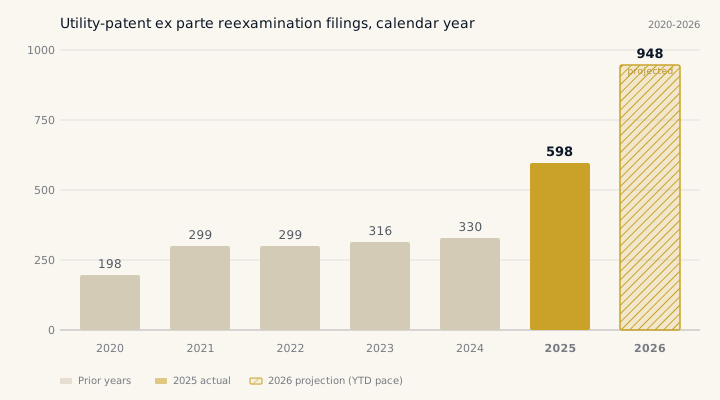
Ex parte reexamination filings on utility patents at the USPTO jumped 81% in 2025, from 330 to 598. The year-to-date pace through May 13, 2026 projects to 948 utility-patent filings for the full year, another 59% above 2025. Two-year cumulative growth from 2024 would exceed 180%.
All filing, outcome, and examiner counts in this preview cover utility-patent ex parte reexaminations. Design and reissue reexams are tracked separately and are not included in the numbers below.
The numbers describe a procedural pivot. PTAB inter partes review used to absorb most invalidity challenges. After the USPTO rescinded the Sotera stipulation as dispositive against discretionary denial in early 2025, and after the broader shift toward discretionary denial of IPR petitions through the year, challengers have returned to ex parte reexam at scale.
This preview pulls three findings from our 2026 index: filing volume and who is driving it, what the profile of one active examiner looks like at depth, and the distribution of rejection bases across 24,000+ individual rejections.
Filing volume
Filings sat at 200-300 per year from 2020 through 2023, climbed to 330 in 2024, then jumped to 598 in 2025. The 395 filings recorded over the first five months of 2026 project to 948 for the full year at the year-to-date monthly pace, another 59% above 2025.
The increase is almost entirely third-party. 561 of the 598 filings in 2025 (94%) were third-party challenges. The 2026 year-to-date split is similar: 380 of 395 (96%) third-party. Patent owner filings have remained flat near their historical baseline. The surge is on the challenger side.
Third parties are using ex parte reexam as a cost-effective alternative to PTAB IPRs. No estoppel attaches to a reexam outcome. The procedure does not require a stipulation, does not depend on discretionary institution, and does not lock the requester out of district court positions on the same grounds.
What we know about one examiner
Peter C. English is the most active ex parte reexam examiner, with 114 utility-patent reexams handled since 2012. 26 are currently open, 88 are closed. We maintain profiles at this depth for 110+ reexam examiners.
The English profile differs materially from the average:
| Metric | Peter C. English | All examiners |
|---|---|---|
| Reexams (open) | 114 (26) | 4,521 (991) |
| Avg pendency | 22.3 mo | 17.4 mo |
| Avg OAs per reexam | 2.2 | 1.5 |
| Rejection bases (102 / 103 / 112 / Other) | 12% / 79% / 8% / 1% | 15% / 72% / 5% / 8% |
| SNQ denial rate | 7% | 5% |
| Cert rate (of closed) | 92% | 94% |
| Appeal rate (of closed) | 49% | 24% |
A reexam in front of English runs about five months longer than the average, generates an extra office action on average, and produces roughly twice the average of PTAB appeals. For a patent owner, that translates to a different cost profile, a different defense posture, and a different conversation with the client than the procedure would otherwise suggest.
Rejection basis distribution
Across 24,000+ individual rejections recorded since 2012:
- 103 (obviousness): 72.0%
- 102 (anticipation): 15.1%
- 112 (specification): 4.7%
- Other (double-patenting, mixed bases, 305 scope rejections, miscellaneous): 8.2%
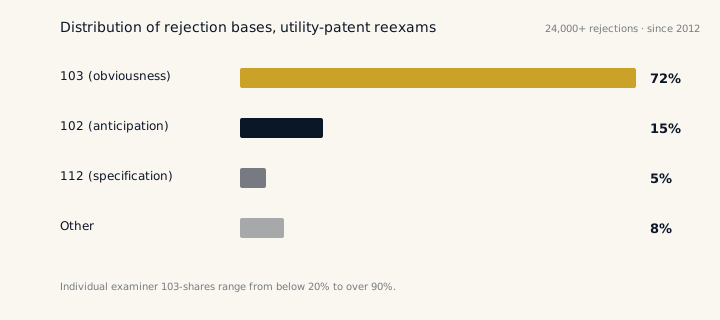
72% is the average. Across 110+ indexed examiners, individual 103-shares range from below 20% to over 90%. Two examiners with substantial caseloads illustrate the spread:
| Examiner | Reexams | 102 | 103 | 112 | Other |
|---|---|---|---|---|---|
| Behzad Peikari | 53 | 5% | 91% | 2% | 2% |
| Jacob C. Coppola | 32 | 17% | 58% | 19% | 6% |
The rejection mix sits with the examiner, not the procedure. A request that leans on a 112 vulnerability has different odds in front of Coppola than in front of Peikari. The same is true at the 102 end of the distribution: some examiners almost never reach a pure 102 ground.
What this preview implies
Three takeaways for anyone working a reexam matter in 2026:
- Volume is the story. The third-party shift back to ex parte reexam is structural rather than seasonal. Pipeline planning should assume the new pace continues unless the procedural environment at the USPTO shifts again.
- The examiner is doing more of the work than the procedure. Pendency, OA count, rejection mix, and appeal rate vary so much across the 110+ active examiners that knowing the assigned examiner is a meaningful input to a realistic cost projection. Aggregate averages obscure that variance.
- Rejection basis is not random. The 72/15/5 split flips by examiner. A theory that lands on a 91%-103 examiner is a different bet than the same theory in front of someone who reaches 102 and 112 nearly as often.
The full 2026 report will publish at year-end with twelve months of post-Sotera data, the 2025 outcome funnel, and updated examiner profiles. This is our snapshot as of May 2026.