State of Ex Parte Reexamination 2025: 598 Filings, +81%
Annual report. 598 ex parte reexamination filings in 2025, an 81% jump from 2024, with 94% third-party. The procedural reset behind the surge.
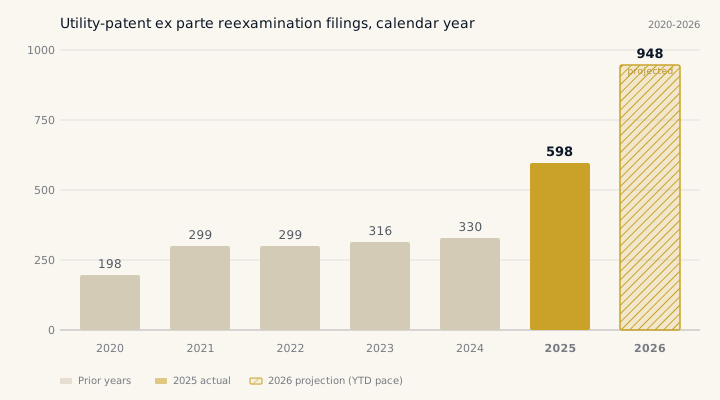
The 2025 ex parte reexamination calendar closed with 598 utility-patent filings, an 81% increase over 2024 (330 filings) and the strongest single-year surge in the procedure's modern history. 561 of those 598 (94%) were third-party requests. This is the headline number behind a market structure shift that the data has spent twelve months confirming. (How the Sotera rescission set this in motion.)
All filing, outcome, and examiner counts in this report cover utility-patent ex parte reexaminations. Design and reissue reexams are tracked separately.
The volume story
Filings climbed from 330 in 2024 to 598 in 2025, a one-year jump of 81%. Annual totals for the prior five-year window (2020-2024) ranged 198 to 330. The previous peak was 2024's 330. 2025 cleared the previous peak by 268 filings.
Filing pace accelerated through the year. Late-year quarterly readings ran above the 2020-2024 average for an entire calendar year. Unified Patents reported 198 filings in Q3 2025 alone, a single quarter that exceeded the entire 2020 calendar year, and a quarterly high for the modern era of ex parte reexam.
The driver is widely acknowledged. The USPTO's early-2025 rescission of the Sotera Stipulation as dispositive against discretionary denial, paired with the PTAB's broader move toward discretionary denial of IPR petitions through the year, reset the cost-benefit calculation for patent challengers. Where IPR previously offered a high-probability path to institution against a willing-to-stipulate petitioner, it now carries genuine institution-denial risk. Ex parte reexam, with its lower cost, no stipulation requirement, and no estoppel, became the natural alternative.
Who is filing
Third-party requesters drove the 2025 surge. 561 of the 598 calendar-year filings (94%) were third-party challenges. Patent owner filings ran 37 in absolute terms, tracking the historical baseline almost exactly. The story is on the challenger side, not the prosecution side.
Among third-party filers, the structural appeal of the procedure is straightforward. No estoppel attaches under 35 U.S.C. 315(e), the way it does for IPR. Filing requirements are lower. The forum decisionmaker is a single examiner rather than a three-judge panel. And there is no discretionary-denial gauntlet at the institution stage.
For challengers holding strong prior art on a patent already in district court litigation, the trade-off increasingly favors the procedure that does not lock in a position.
Outcomes (so far)
Most 2025 filings are still pending. Average pendency runs 17.4 months since 2012, so the 2025 cohort will not fully close out until 2026-2027. For the 4,521 closed reexams that have already closed, the outcome distribution is stable:
- Certificate issued: 94% of closed cases.
- SNQ denied at the gate: 5%.
- Other terminations: approximately 1%.
A "certificate issued" outcome does not mean all original claims survived. The certificate records what changed: claims confirmed, claims amended, claims canceled, and any new claims added. The expected end-state of a 2025 reexam is some combination of those, not a full pre-reexam claim set walking out the other side.
Examiners and pendency variance
The 598 new filings will land across roughly 110 active reexam examiners. Caseload concentration is uneven: the top five examiners by volume each handle 70+ reexams , with the most active at 114 cases. Pendency, OA count, and appeal rate vary materially across that population.
For a 2025 filing assigned to an above-average pendency examiner, the realistic timeline is closer to two years than to the 17.4-month index average. For a patent owner whose examiner has a 49% appeal rate (more than twice the 24% average), the cost projection has to include a probable PTAB appeal as part of the base case. The procedure is uniform; the population that runs it is not.
What to watch in 2026
Two storylines will shape the year:
First, filing volume. If the late-2025 monthly pace holds, 2026 closes well above 600 filings, with a top-end scenario approaching 1,000. Whether the new equilibrium sustains depends on the USPTO's discretionary-denial framework, the new Director's procedural priorities, and any USPTO procedural changes that affect the SNQ gate.
Second, the 5% denial floor. The historical SNQ grant rate is roughly 95%. The 2025 surge brought a wider population of requesters to the procedure, many migrating from IPR with prior art tuned to PTAB rather than to MPEP 2240. Whether the SNQ denial rate moves under that pressure is the central data question for the procedure in 2026.
The 2025 calendar made ex parte reexam a primary invalidity vehicle again. The next year will reveal whether the procedure scales with the audience it is now attracting.