Ex Parte Reexamination Has Overtaken the IPR. The Data to Navigate It Hasn't Caught Up.
Discretionary denials pushed patent challenges out of the PTAB and into ex parte reexamination, a forum that turns on one variable almost no one measures: the assigned examiner. What the mid-2026 numbers say, and what they cannot.
Something structural happened to patent validity challenges this year. In a four-week stretch this spring, the PTAB received eleven inter partes review petitions, the lowest count since the system opened in September 2012, when petitions routinely ran 80 to 130 in a comparable window. Over the same period, ex parte reexamination requests climbed past 130 at their peak. For the first time, ex parte reexamination has overtaken the IPR as the leading tool for challenging an issued patent at the USPTO. The surge we tracked at the end of 2025 did not just continue. It crossed over.
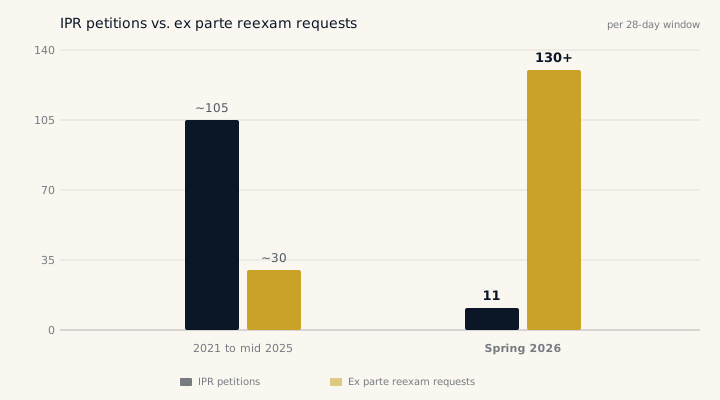
The cause is no mystery. Starting in 2025 under Acting Director Coke Morgan Stewart and accelerating under Director John Squires, the USPTO rebuilt its discretionary-denial practice for IPRs. Institution rates fell from roughly 68% in 2024 to under 40% by December 2025, and the discretionary-denial rate on cases reaching the new briefing process has run around 60%. Challengers who once defaulted to the PTAB needed a forum that discretion could not so easily close. Ex parte reexamination was sitting right there: granted at roughly 95%, with no Fintiv analysis, no estoppel, no one-year filing bar, the option of anonymity, and a fraction of the cost.
The migration shows up in the filing counts. Utility-patent ex parte reexamination filings in our index rose 81% in a single year, from 330 in 2024 to 598 in 2025, and 2026 is on pace for 948 at the current rate. The reexam resurgence is now the most-covered procedural story in patents, and the firms have noticed: Baker Botts called the comeback in August 2025, Sughrue ran a January 2026 piece under the headline "Hello Reexam, My Old Friend," and BakerHostetler, Morgan Lewis, Crowell, Finnegan, and Sterne Kessler have all published on the shift.
The forum you land in is not the forum you left
Here is the part the filing charts miss. An ex parte reexamination is not a quieter IPR. It is a different proceeding with a different center of gravity. In an IPR, two sophisticated parties argue to a three-judge panel on a schedule fixed by statute. In an ex parte reexamination, the requester files, and then, with narrow exceptions, the requester is finished. After the request is granted, validity is decided in a one-on-one exchange between the patent owner and a single examiner, with no adversary in the room to test the patent owner's arguments and no panel to balance the call. (A closer look at who decides your reexam.)
That examiner controls more than the outcome. They control the clock. By statute, the decision on whether a substantial new question of patentability exists must come within three months of filing. After that, there are no set timing requirements for the next office action. Reexaminations are conducted with "special dispatch," a phrase the USPTO has never defined.
What the numbers actually say
None of this makes reexamination a coin flip. It means the odds are real but uneven, and they sit buried in aggregates that hide the variable that matters.
Grant is close to automatic. The USPTO grants reexamination on a substantial new question in about 95% of requests, and only about 5% are turned away at the gate. Compare that to an IPR institution rate that ran near 68% in 2024 and has fallen under 40% through 2025. Getting in is easy. Getting the result you want is not.
A certificate issues in about 94% of closed cases, but a certificate is not the same as survival. Most reflect amended or partially cancelled claims. Among litigated patents specifically, all claims survive intact only about 37% of the time, every claim is cancelled in only about 21%, and the rest land somewhere in between. Reexamination rarely kills a patent outright. It narrows one, which is why Sterne Kessler describes the usual result as a patent that does "eventually issue" with claims that are "almost always amended." For challengers weighing the two forums, that tradeoff is the heart of the reexam versus IPR decision.
Who holds the patent moves the numbers further. Non-practicing entities see the highest cancellation rate, around 47%, while large operating companies see the highest rate of fully confirmed claims, around 62%. Same forum, very different expected value depending on the matchup.
Timelines spread out even more. Average pendency runs about 17.4 months across our index of closed reexaminations, but that average hides a wide split: cases that end without an appeal run around 13 months, the roughly one in four that draw a PTAB appeal stretch past 30, and the few that reach the Federal Circuit run past 48. First office actions have recently issued six to seven months after filing. The early deadlines look like an IPR. The later ones do not.
The variable everyone names and no one measures
Read enough of the commentary and a pattern emerges. Every firm writing about reexamination names the same decisive variable, and not one of them can quantify it. BakerHostetler says the new regime has "made outcomes harder to predict." Morgan Lewis warns of "greater uncertainty and less transparency." Sughrue notes that the office issues mostly "summary notices," so there are "no detailed citable opinions" to reason from. And Jarom Kesler of Knobbe, reacting to a surprise denial this June, said the quiet part out loud: "I've done probably 50 ex parte reexams in the last 15 years, and this is the first time I've ever seen this kind of an outcome."
The honest version comes from counsel at Unified Patents, writing in the ABA's Landslide: the available data "lacks the granularity needed for a party to make an informed decision about whether a reexamination will help or hurt their chances in litigation." That is the whole problem in one sentence. The forum is examiner-driven. The examiner is assigned, not chosen. And the public statistics stop exactly where the examiner begins.
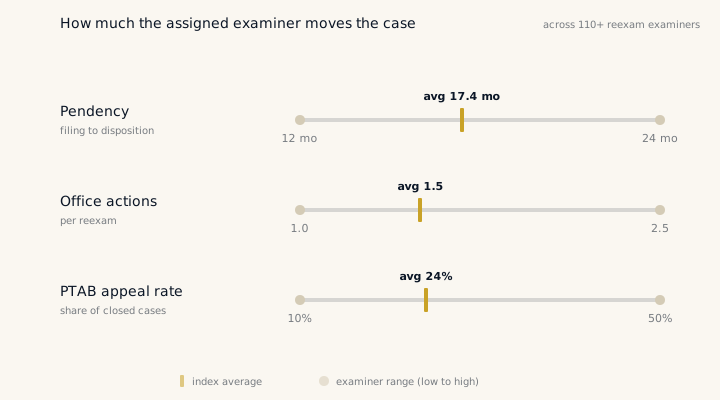
The spread is not noise. Across the active examiner population, pendency varies about 2x from the fast end to the slow end, office action counts vary about 2.5x, and PTAB appeal rates vary about 5x. (Why the examiner is the bigger variable than the procedure.) When practitioners say a reexamination "depends on the examiner," they are right, and until recently that was where the analysis ended, because no one had the examiner-level numbers to go further. That is the layer we built ExamPat to supply. For the examiner actually assigned to your case, the aggregate dissolves into specifics: how often they confirm all claims versus force amendments, how long their cases run from filing to certificate, how often they decline to find a substantial new question, and how their decisions hold up on appeal.
What to watch
The predictability question is about to get sharper, not softer. The same discretion that emptied the PTAB is starting to reach into reexamination. In May 2026 the USPTO denied a reexamination under 35 U.S.C. 325(d) because the request recycled art from a discretionarily denied IPR, a move many practitioners had never seen. An April 2026 pre-order procedure now lets patent owners argue against a substantial new question before the reexamination is even ordered. And in November 2025, Director Squires ordered a reexamination of a Nintendo patent on his own initiative, the first agency-initiated ex parte reexamination in more than a decade. Any recently issued, high-visibility patent can now be pulled into this forum with no petition to answer.
More patents are entering reexamination, the rules are moving, and the published data still cannot tell you what the assigned examiner is likely to do. The teams that navigate the rest of 2026 well will be the ones who stop reasoning from the forum's averages and start reasoning from the examiner's record. That record exists. It was just never collected in one place.
Frequently asked questions
Has ex parte reexamination really overtaken inter partes review?
Yes. As of spring 2026, ex parte reexamination requests surpassed IPR petitions for the first time since the AIA. In one four-week window the PTAB received only eleven IPR petitions, the lowest since the system began in September 2012, while reexamination requests climbed past 130. The reversal is driven by the USPTO's discretionary-denial crackdown on IPR institution.
Sources: Patently-O
Why are patent challengers switching from IPR to ex parte reexamination?
Discretionary denials pushed IPR institution rates from roughly 68% in 2024 to under 40% by the end of 2025. Ex parte reexamination is granted about 95% of the time, carries no estoppel, has no one-year filing bar, allows anonymous filing, and costs a fraction of an IPR. The tradeoff is control: after the request is filed, the requester drops out and a single examiner runs the proceeding.
Sources: Baker Botts · Crowell & Moring
How predictable is the outcome of an ex parte reexamination?
Less predictable than an IPR, because the assigned examiner drives both the timeline and the result. Across the reexam examiner population, pendency varies about 2x (roughly 12 to 24 months), office action counts about 2.5x, and PTAB appeal rates about 5x (roughly 10% to 50%). Published statistics report only population averages, so the single variable that most determines a case is the one aggregate data leaves out.
Sources: ABA Landslide / Unified Patents