IPR Discretionary Denial: Fintiv, Sotera and Settled Expectations
How IPR discretionary denial works in 2026: the Fintiv factors, Sotera stipulations, settled expectations, the pending PTAB rule and options after a denial.
Discretionary denial is the USPTO's refusal to institute an inter partes review (IPR) or post-grant review (PGR) for reasons that have nothing to do with whether the patent is valid. Since 2025 it has become the single biggest reason petitions fail. In fiscal year 2026, 79% of denied IPR and PGR petitions were turned away on discretionary grounds, and the institution rate fell to 41%.
This guide explains where the discretion comes from, how the Fintiv factors, Sotera stipulations and the newer settled expectations doctrine work, what the pending PTAB rule would change, and what challengers and patent owners are doing about it. It draws on the statute, USPTO memos and precedential decisions, and commentary from IP practitioners. Last updated October 19, 2026.
At a glance
| Legal basis | 35 U.S.C. 314(a) for IPR, 324(a) for PGR, 325(d) for previously presented art |
| Who decides | The USPTO Director, since October 20, 2025, consulting at least three judges |
| Main factors | Parallel litigation (Fintiv), settled expectations, prior challenges, strength of the merits |
| Sotera stipulation | Relevant but no longer dispositive since March 2025 |
| Institution rate | 41% by petition in FY2026, against 50% in FY2025 and 68% in FY2024 |
| Share of denials that were discretionary | 79% in FY2026 |
| Appeal | None. Institution decisions are final and nonappealable |
| Pending rule | Proposed October 2025, final rule under White House review since July 2026 |
Where the discretion comes from
The AIA sets a floor for IPR, not a guarantee. Under 35 U.S.C. 314(a), the Director may not institute unless the petition shows a reasonable likelihood that the petitioner will prevail on at least one claim. Nothing in the statute requires institution when that bar is met. For PGR, 35 U.S.C. 324(a) uses a higher "more likely than not" threshold with the same open-ended discretion.
A second source is 35 U.S.C. 325(d), which lets the Director reject a petition when the same or substantially the same art or arguments were already presented to the Office. The PTAB applies it through the two-step framework in Advanced Bionics v. MED-EL: was the art or argument previously presented, and if so, did the Office err in a way material to patentability? The Becton, Dickinson factors fill in both steps.
The PTAB has also long denied serial petitions under General Plastic v. Canon, which asks whether the same petitioner already challenged the same claims and why it waited, and it discourages parallel petitions against one patent. In January 2026 it made PacifiCorp v. Birchtech precedential, instituting at most one petition per patent.
The Fintiv factors
Fintiv is the framework for denying review because of parallel litigation. In Apple v. Fintiv, designated precedential in May 2020, the PTAB set out six factors:
- Whether the court granted a stay or evidence exists that one may be granted if review is instituted.
- How close the court's trial date is to the PTAB's deadline for a final written decision.
- How much the court and the parties have invested in the parallel case.
- How much the issues in the petition overlap with those in the parallel case.
- Whether the petitioner and the defendant in the parallel case are the same party.
- Other circumstances, including the merits.
The PTAB weighs them together rather than as a checklist. In June 2022 Director Vidal narrowed Fintiv by memo: no denial where the petition presented compelling merits, none based on an ITC case, and none where the petitioner filed a Sotera stipulation. The USPTO rescinded that memo on February 28, 2025. A March 24, 2025 guidance memo restored Fintiv for ITC cases and said compelling merits are no longer dispositive.
Sotera stipulations
A Sotera stipulation is the petitioner's answer to Fintiv factor 4. In Sotera Wireless v. Masimo, the petitioner promised that if the IPR was instituted it wouldn't pursue in district court the grounds raised in the petition or any ground it reasonably could have raised. That removed most of the overlap with the litigation, and the PTAB instituted.
From 2022 through early 2025, a timely Sotera stipulation generally took Fintiv off the table. Since the March 24, 2025 guidance, it's "highly relevant, but will not be dispositive by itself," and it has to be filed before the institution decision. Baker Botts has advised that stipulations should be precise and comprehensive rather than boilerplate. The USPTO's own Tesla v. Bulletproof decision, designated informative in June 2026, credited a broad stipulation together with a vacated trial date. (Our analysis of the Sotera change.)
The 2025 overhaul
On March 26, 2025, Acting Director Stewart issued an interim process that split institution in two. The Director decides discretionary denial first, on separate briefing. The patent owner's brief is due within two months of the notice of filing date and the petitioner's opposition a month later, each limited to 20 pages. Only petitions that survive go to a panel on the merits.
The memo listed what the Director would consider:
- Whether the PTAB or another forum has already ruled on the patent's validity
- Changes in law or precedent since the claims issued
- The strength of the unpatentability challenge
- How heavily the petition relies on expert testimony
- The settled expectations of the parties, such as how long the claims have been in force
- Compelling economic, public health or national security interests
- Any other considerations, along with the PTAB's workload
A March 11, 2026 memo added three more: whether the accused products are made in the US, whether the patent owner's own products are, and whether the petitioner is a small business that has been sued.
Settled expectations
Settled expectations is the factor that changed the most outcomes. The idea is that the longer a patent has been in force without challenge, the more its owner and the public are entitled to rely on it. The first denial on this ground came in iRhythm v. Welch Allyn in June 2025, against patents in force since 2012 that the petitioner had itself cited years earlier.
There's no fixed age. The USPTO's informative decisions say only that expectations grow more settled the longer a patent is in force, and one found them settled at three years. In practice the line has been around six years. A Finnegan analysis of decisions from June to August 2025 found patents six years and older were mostly denied and patents four years and younger mostly referred to the merits. Kilpatrick Townsend reached the same conclusion in November 2025.
Patent owners have a counterweight to watch for. Foley & Lardner reported in August 2026 that clear examiner error has outweighed settled expectations even for patents 15 to 18 years old, and the USPTO has declined to deny where a patent was never commercialized.
The Director decides institution
On October 17, 2025, Director Squires went further. His memo made the Director the decision maker on every IPR and PGR institution from October 20, 2025, on both discretionary grounds and the merits, after consulting at least three administrative patent judges. Routine grants and denials now issue as summary notices without a written explanation. Reasoned decisions are reserved for novel or important issues.
Some of those reasoned decisions have become precedent. In Magnolia v. Kurin, designated precedential in May 2026, the Director denied institution after a jury had found the claims not invalid, describing AIA review as an alternative to litigation rather than a second chance.
What the numbers show
The effect shows up plainly in the USPTO's own statistics. The institution rate was 68% by petition as recently as FY2024.
| Fiscal year | Petitions filed | Institution rate (by petition) | Discretionary share of denials |
|---|---|---|---|
| FY2025 | 1,433 | 50% | 49% |
| FY2026 | 500 | 41% | 79% |
Sources: USPTO FY2025 roundup, USPTO September 2026 statistics. Discretionary share is discretionary denials divided by all denials.
In FY2026 the Director denied 438 of 782 petitions at the discretionary stage. Of petitions decided on the merits, 77% were instituted, so a petition that survives the discretionary stage now has good odds. Getting there is the hard part. Filings fell by about two thirds in a year, and Unified Patents counted just 57 IPR petitions in the second quarter of 2026, the lowest on record.
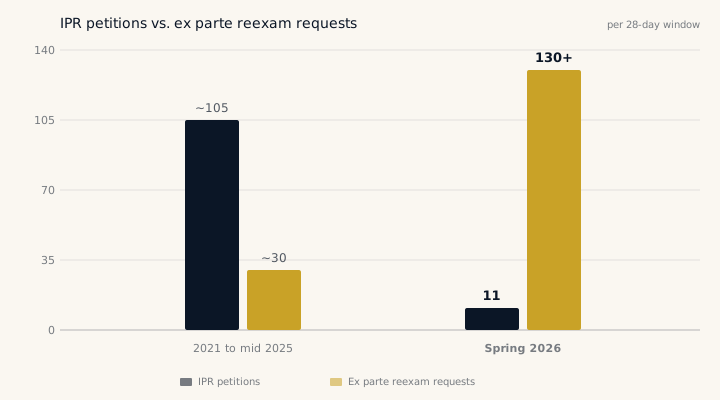
Challengers didn't disappear. They moved. Ex parte reexamination requests have outnumbered PTAB petitions for four straight quarters through the third quarter of 2026, according to Unified Patents. (How reexam overtook the IPR.)
Can a discretionary denial be challenged?
Not effectively. Under 35 U.S.C. 314(d), institution decisions are final and nonappealable, and the courts have held firm through the 2025 changes.
- In In re Motorola Solutions (November 2025, precedential), the Federal Circuit denied mandamus, holding that institution and de-institution are unreviewable and that petitioners had no protected interest in the rescinded Vidal memo.
- In In re Cambridge Industries (December 2025), the first challenge aimed at settled expectations, the court denied mandamus without deciding whether the factor is lawful.
- In Apple v. Squires (February 2026, precedential), the court held the Fintiv instructions were a general policy statement that didn't need notice-and-comment rulemaking.
- On October 19, 2026, the Supreme Court declined to hear Google's challenge in Google v. VirtaMove. Petitions from Intel, Tesla and Kahoot! were still pending.
The pending PTAB rule
The USPTO proposed codifying and expanding discretionary denial in an October 17, 2025 rulemaking for IPR. As proposed, it would:
- Require a broad stipulation. No IPR unless the petitioner and its real parties in interest stipulate that they won't raise 102 or 103 invalidity in any other proceeding.
- Bar claims already upheld. No IPR on a claim that was found not invalid under 102 or 103 in a district court trial or summary judgment, an ITC determination, a PTAB final written decision or a third-party ex parte reexamination.
- Defer to faster forums. No IPR if a district court trial, ITC determination or other PTAB decision on 102 or 103 is more likely than not to come first.
- Leave a narrow exception. Only the Director could override, in extraordinary circumstances that don't include new art, new expert testimony or new arguments.
The final rule went to the White House Office of Information and Regulatory Affairs on July 22, 2026, according to reginfo.gov, and hadn't been published as of this update. Practitioners expect court challenges once it is. The reexam provision matters for anyone thinking about sequencing: a claim confirmed in a third-party reexam would be off limits for IPR.
What challengers are doing
Practitioner advice has converged on a few points:
- Move early. File before litigation advances and before the patent ages. Baker Botts flagged extra scrutiny for patents eight years and older, and Kilpatrick treats six years as the practical line.
- Make the record. Put manufacturing location, small business status and any examiner error in the opposition. Sterne Kessler and Foley both stress examiner error as the strongest counterweight.
- Stipulate fully. A narrow Sotera stipulation is unlikely to carry much weight under the current guidance.
- Use PGR when you can. The USPTO's precedential Multi-Color v. Brook & Whittle decision favors PGR petitions, which makes the nine-month window after a competitor's patent issues more valuable.
- Plan the reexam carefully. Ex parte reexamination is the most common alternative, but it isn't a clean second shot.
That last point became concrete in May 2026. The USPTO denied an ex parte reexamination request under 325(d) because its art had been argued in an IPR petition that was itself denied on settled expectations, without the merits ever being reached. BakerHostetler concluded that the first attempt to bring art to the Office may now matter more than any that follow, and suggested filing the reexam first. Mintz advised choosing one vehicle rather than both, or varying the claims, references and theories.
ExamPat's data on reexams filed after a discretionary IPR denial shows the door isn't closed: in 2026, three in four of those requests were still granted. (Is reexam still worth filing after a discretionary IPR denial?) For how the procedure works, its fees and typical timeline, see our guide to ex parte reexamination.
What patent owners are doing
Owners now treat the discretionary brief as the main event. Every discretionary argument has to be in the brief due two months after the notice of filing date, so owners build the record early: the litigation schedule, investment in the case, overlap with the petition, how long the patent has been in force and any reliance on it.
Owners facing a reexam after a denied IPR have a new argument too. Mintz advises raising 325(d) when the request repeats art from the earlier petition. Since April 2026, owners can also answer a reexam request before the order with a pre-order paper. (How the pre-order paper works.)
Timeline
- May 2020: Apple v. Fintiv designated precedential.
- December 2020: Sotera Wireless v. Masimo decided, later designated precedential.
- June 21, 2022: Vidal memo limits Fintiv denials.
- February 28, 2025: Vidal memo rescinded.
- March 24, 2025: Guidance makes Sotera stipulations relevant but not dispositive and restores Fintiv for ITC cases.
- March 26, 2025: Interim process splits institution into a discretionary stage and a merits stage, and introduces settled expectations.
- June 6, 2025: First denial on settled expectations, in iRhythm v. Welch Allyn.
- October 17, 2025: The Director takes over institution decisions, and the USPTO proposes the discretionary denial rule.
- November 2025: In re Motorola Solutions confirms institution decisions are unreviewable.
- February 2026: Apple v. Squires upholds the Fintiv instructions without notice-and-comment rulemaking.
- March 11, 2026: US manufacturing and small business considerations added.
- May 2026: Magnolia v. Kurin made precedential. The USPTO denies a reexam under 325(d) after a discretionary IPR denial.
- July 22, 2026: Final rule sent to the White House for review.
- October 19, 2026: Supreme Court declines to hear Google v. VirtaMove.
This page is updated as the rules change. Last updated October 19, 2026.
Frequently asked questions
What is discretionary denial of an IPR?
Discretionary denial is the USPTO's refusal to institute an inter partes review for reasons other than the merits of the petition. The statute says the Office may not institute unless the petitioner shows a reasonable likelihood of success, but it never requires institution, so the Director can decline even a strong petition because of parallel litigation, the age of the patent, earlier challenges or other policy factors.
Sources: 35 U.S.C. 314
What are the Fintiv factors?
The six Fintiv factors are whether the court granted or may grant a stay, how close the trial date is to the PTAB's deadline for a final written decision, how much the court and parties have invested in the litigation, how much the issues overlap, whether the petitioner is the defendant in the litigation, and any other circumstances, including the merits. The PTAB weighs them together.
Sources: Apple v. Fintiv, IPR2020-00019
What is a Sotera stipulation?
A Sotera stipulation is a petitioner's promise that, if the IPR is instituted, it won't pursue in district court the same invalidity grounds or any ground it raised or reasonably could have raised in the IPR. From 2022 to early 2025 a timely Sotera stipulation generally avoided a Fintiv denial. Since March 2025 the USPTO treats it as highly relevant but not dispositive.
What does settled expectations mean at the PTAB?
Settled expectations is a discretionary denial factor introduced in 2025. The longer a patent has been in force without challenge, the more the USPTO treats the owner's reliance on it as a reason not to institute review. There is no bright line, but practitioner analyses found patents six years and older were usually denied on this ground and patents four years and younger usually were not.
Sources: Finnegan via IAM
Can a discretionary denial of IPR be appealed?
No. Under 35 U.S.C. 314(d) the decision whether to institute is final and nonappealable. The Federal Circuit has rejected every mandamus petition and APA challenge to the 2025 discretionary denial regime, including In re Motorola Solutions in November 2025 and Apple v. Squires in February 2026.
Sources: Morgan Lewis
What is the IPR institution rate in 2026?
The USPTO reported an institution rate of 41% by petition for fiscal year 2026, down from 50% in FY2025 and 68% in FY2024. Petition filings fell to 500 in FY2026 from 1,433 the year before, and 79% of FY2026 denials were discretionary rather than on the merits.
Sources: USPTO PTAB trial statistics
What can a challenger do after an IPR is discretionarily denied?
The main options are ex parte reexamination, a PGR if the patent is still within nine months of issuance, or an invalidity defense in district court or at the ITC. Reexam is the most common route, but since May 2026 the USPTO has shown it can deny a reexam request under 325(d) when it repeats art from a discretionarily denied IPR.
Sources: BakerHostetler
Is the new PTAB discretionary denial rule final?
Not yet. The USPTO proposed it in October 2025. It would require petitioners to give up 102 and 103 invalidity defenses elsewhere and bar IPR on claims already upheld in court, at the ITC, at the PTAB or in a third-party ex parte reexamination. The final rule went to the White House Office of Information and Regulatory Affairs for review on July 22, 2026 and hadn't been published as of October 19, 2026.
Sources: reginfo.gov